
…as part of the Introspective: Contemplations on Curating Exhibition
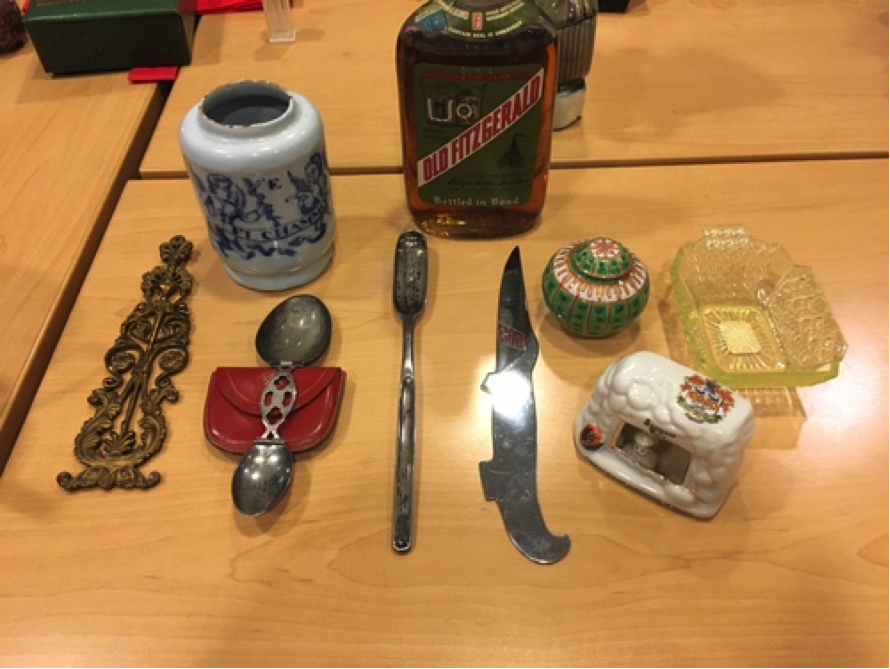
Photograph from an Introspective brainstorming session.
The exuberance of the sunshine yellow translucent pressed glass on display in Introspective initially seems misleading. The pressed glass sauceboat was colored using uranium, a potentially harmful radioactive element. The piece is displayed as an element in one of the exhibition’s potential curatorial themes called “Deadly,” along with other objects that could be considered deadly or make reference to death. It rests alongside a knife, an apothecary jar, and a small figurine of a World War One soldier. However, the sauceboat’s negligible levels of uranium are in fact harmless, and pieces like it have become charming collector’s items.
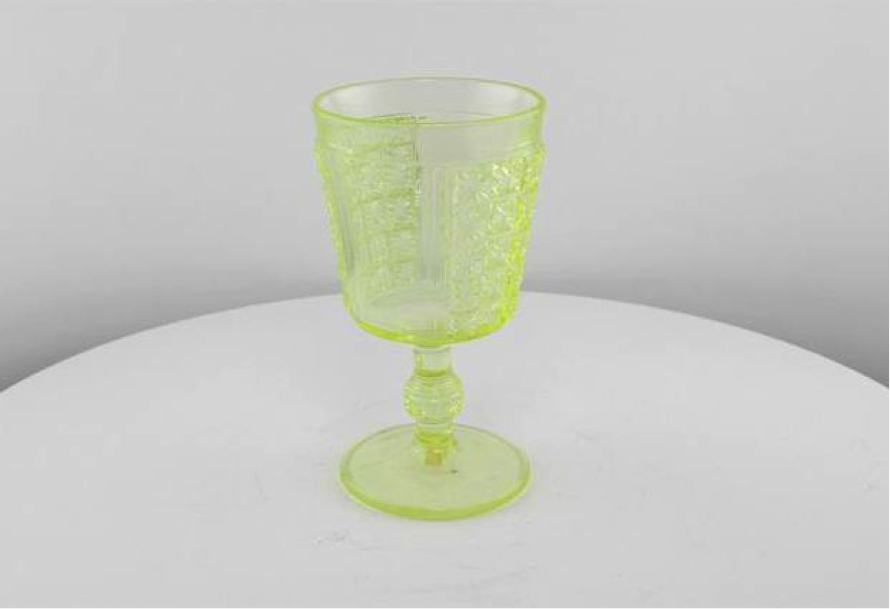
Another piece of uranium glass in BGC’s study collection.
The popularity of uranium glass began in the 1880s. Depending on the state of the uranium used in production, the resulting glass was a unique transparent yellow-green color sometimes described as “greasy.” The colors of uranium glass range from an opaque yellow called custard glass, to opaque green called jadite glass, and an opaque pink called Burmese glass. In the 1920s, uranium glass was sometimes referred to as “vaseline glass” because it resembled the yellow, oily color of petroleum jelly, a popular product of the time.
The sauceboat on display, dating to about 1880, probably has a uranium content of as low as two percent, though some pieces contained up to twenty-five percent uranium. After World War Two, uranium use was restricted by the government and production slowed. However, there are artists today who create uranium glass pieces, such as Ken and Julia Yonetani, who make glowing glass installations with political and social messages. Under ultraviolet light, uranium glass glows bright green due to its radioactivity.

Ken + Julia Yonetani, What the Birds Knew (2012) (4A Center for Contemporary Asian Art). Uranium glass, metal wire, UV lights, Courtesy of the artists.
The multiple associations of uranium glass, as an unintentionally dangerous product, to collector’s pieces and art objects, demonstrates the idea of multiple points-of-view that Introspective aims to prompt. Here, the uranium sauceboat is placed in the “Deadly” category as one possible curatorial theme, but it could just as easily fit in with the harmless “Forms” category. It’s placement invites visitors to take part in the curatorial process and consider the multiple perspectives from which objects can be viewed.
Sources and further reading:
Marks, Ben. “These People Love to Collect Radioactive Glass. Are They Nuts?” Collectors Weekly. N.p., 30 July 2014. Web. 11 Apr. 2016. http://www.collectorsweekly.com/articles/these-people-love-to-collect-radioactive-glass/.
“Vaseline and Uranium Glass (ca. 1930s).” Vaseline and Uranium Glass (ca. 1930s). Oak Ridge Association Universities, n.d. Web. 11 May 2016. https://www.orau.org/ptp/collection/consumer%20products/vaseline.htm
Ikeda, Asato. “On Uranium Art: Artist Ken + Julia Yonetani in Conversation with Asato Ikeda ウラン・アートについて-アーチスト・ケンとジュリア・ヨネタニに池田安里が聞く.” On Uranium Art: Artist Ken + Julia Yonetani in Conversation with Asato Ikeda –. The Asia-Pacific Journal, 18 Mar. 2013. Web. 11 Apr. 2016. http://apjjf.org/2013/11/11/Asato-Ikeda/3915/article.html
Post Author: Clara Boesch