
The Creative Team:
Clara Boesch Anne Carlisle Maggie Frick Cindy Kok Caroline O’Connell Alyssa Velazquez Angelik Vizcarrondo-Laboy
Acknowledgments
Susan Weber
Peter N. Miller
Elena Pinto Simon
Jeffrey Collins
Deborah Krohn
Barb Elam
Mike Satalof
Heather Topcik
Kate DeWitt
Ian Sullivan
Nina Stritzler-Levine
Eric Edler
Tim Ettenheim
James Congregane
Chandler Small
Laura Minsky
Margaret Loughlin
Elvis Kabaj
Stephen Nguyen
Lorenzo Lugo
Gilberto Rivera
Jose Olivera
Jesse Merandy
Joseph Loh
Jon Prown
Sarah Anne Carter
Melissa Hartley Omholt
Natalie Wright
Steven Lubar
Glenn Adamson
Elizabeth Duffy
Sylvia Yount
Ronda Kasl
Nonnie Frelinghuysen
Moira Gallagher
The Multiple Identities of Uranium Glass
…as part of the Introspective: Contemplations on Curating Exhibition
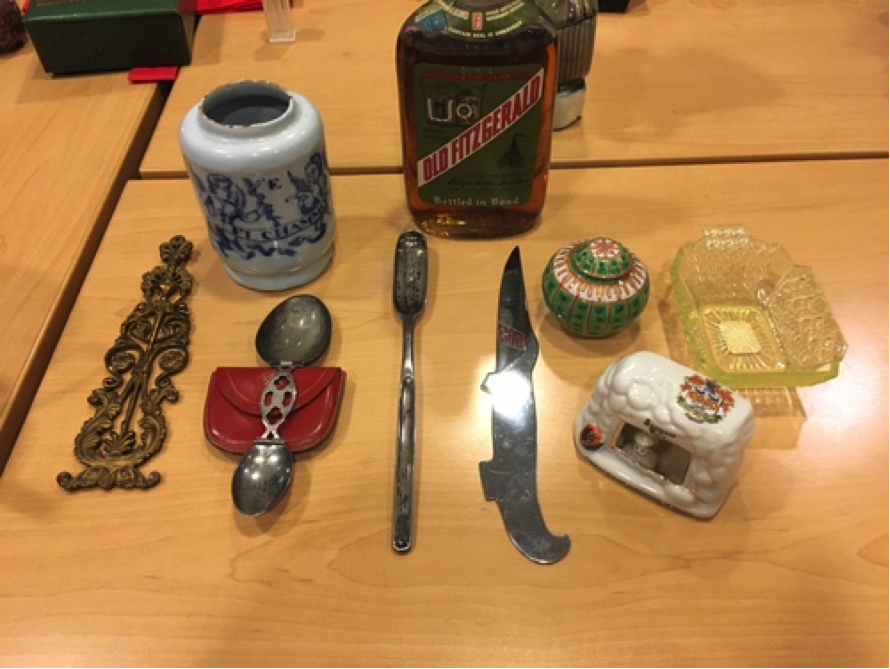
Photograph from an Introspective brainstorming session.
The exuberance of the sunshine yellow translucent pressed glass on display in Introspective initially seems misleading. The pressed glass sauceboat was colored using uranium, a potentially harmful radioactive element. The piece is displayed as an element in one of the exhibition’s potential curatorial themes called “Deadly,” along with other objects that could be considered deadly or make reference to death. It rests alongside a knife, an apothecary jar, and a small figurine of a World War One soldier. However, the sauceboat’s negligible levels of uranium are in fact harmless, and pieces like it have become charming collector’s items.
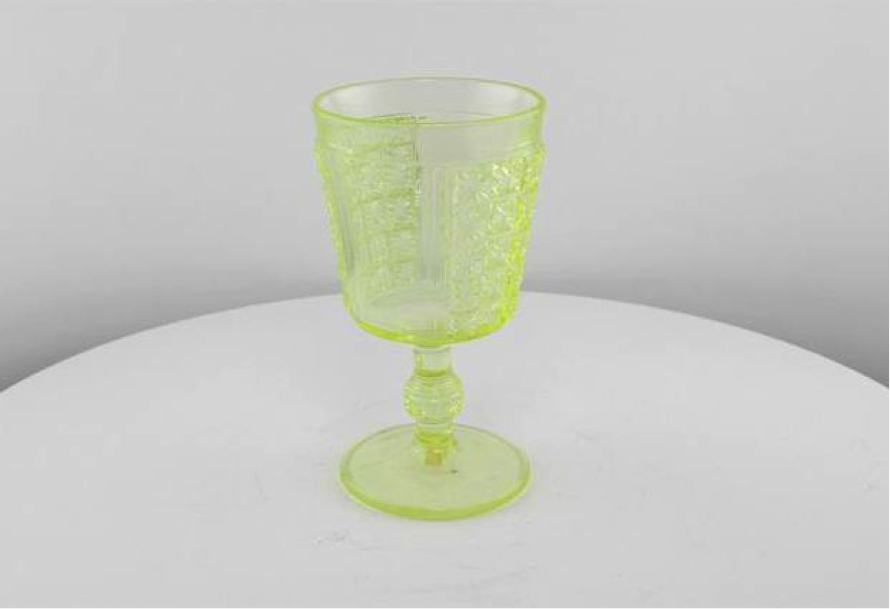
Another piece of uranium glass in BGC’s study collection.
The popularity of uranium glass began in the 1880s. Depending on the state of the uranium used in production, the resulting glass was a unique transparent yellow-green color sometimes described as “greasy.” The colors of uranium glass range from an opaque yellow called custard glass, to opaque green called jadite glass, and an opaque pink called Burmese glass. In the 1920s, uranium glass was sometimes referred to as “vaseline glass” because it resembled the yellow, oily color of petroleum jelly, a popular product of the time.
The sauceboat on display, dating to about 1880, probably has a uranium content of as low as two percent, though some pieces contained up to twenty-five percent uranium. After World War Two, uranium use was restricted by the government and production slowed. However, there are artists today who create uranium glass pieces, such as Ken and Julia Yonetani, who make glowing glass installations with political and social messages. Under ultraviolet light, uranium glass glows bright green due to its radioactivity.

Ken + Julia Yonetani, What the Birds Knew (2012) (4A Center for Contemporary Asian Art). Uranium glass, metal wire, UV lights, Courtesy of the artists.
The multiple associations of uranium glass, as an unintentionally dangerous product, to collector’s pieces and art objects, demonstrates the idea of multiple points-of-view that Introspective aims to prompt. Here, the uranium sauceboat is placed in the “Deadly” category as one possible curatorial theme, but it could just as easily fit in with the harmless “Forms” category. It’s placement invites visitors to take part in the curatorial process and consider the multiple perspectives from which objects can be viewed.
Sources and further reading:
Marks, Ben. “These People Love to Collect Radioactive Glass. Are They Nuts?” Collectors Weekly. N.p., 30 July 2014. Web. 11 Apr. 2016. http://www.collectorsweekly.com/articles/these-people-love-to-collect-radioactive-glass/.
“Vaseline and Uranium Glass (ca. 1930s).” Vaseline and Uranium Glass (ca. 1930s). Oak Ridge Association Universities, n.d. Web. 11 May 2016. https://www.orau.org/ptp/collection/consumer%20products/vaseline.htm
Ikeda, Asato. “On Uranium Art: Artist Ken + Julia Yonetani in Conversation with Asato Ikeda ウラン・アートについて-アーチスト・ケンとジュリア・ヨネタニに池田安里が聞く.” On Uranium Art: Artist Ken + Julia Yonetani in Conversation with Asato Ikeda –. The Asia-Pacific Journal, 18 Mar. 2013. Web. 11 Apr. 2016. http://apjjf.org/2013/11/11/Asato-Ikeda/3915/article.html
Post Author: Clara Boesch
Have You Served a Jell-O Salad Lately?
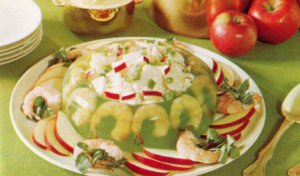
Jello with shrimp frosting. Chicken mousse. Liver pâté en masque. These innovative, if perhaps somewhat nauseating, recipes typically date to the late 1940s and 50s and have since faded out of popularity. While often visually appealing — at least in pictures — these recipes often featured an unusual combination of ingredients and relied heavily on Jell-O or aspic. What prompted this mid-century fascination with suspending pickled vegetables and canned meats in gelatin and calling it a meal?
World War II encouraged the food industry to invent new methods for extending the shelf-life through freezing, canning, dehydrating and other kinds of packaging. After wartime rationing and restrictions were lifted, manufacturers needed to find new ways to convince domestic consumers to continue purchasing these food products. To encourage brand loyalty, companies would print brand-specific cookbooks or recipes, trying to limit the recipe to foods made by their own company.
While companies often included newly invented recipes in their product advertisements, housewives also experimented with new cooking techniques meant to simply their kitchen routines. The idea of “better living through chemistry” permeated households. Jell-O successfully capitalized on this concept in their advertisements, which emphasized the simplicity of cooking with jello. Inventions like Jell-O salad and other Jell-O entrees allowed household cooks to present food in an appealing way while also preserving it for days longer.
Home cooks would have used devices like the rose-gold colored mold in Bard Graduate Center’s study collection to shape their creations. Creations such as “Ring Around the Tuna” (chunks of tuna, pimientos, and cucumbers in molded lime Jell-O) would be poured into a mold and set before usually being served as a starter or salad.
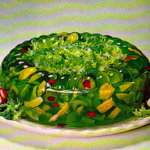
Presentation was especially key. Another jello salad recipe suggests cutting vegetables like cucumbers and carrots into fish shapes to add to lime Jell-O. After it sets, the recipe instructs the cook to top it with layers of Hellman’s mayonnaise.
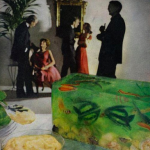
Although the fashion for homemade savory gelatin is no longer in vogue, the ideas behind 1950s food science remains present on grocery shelves today, where pre-packaged foods have only grown in popularity and Jell-O and Spam remain household names.
If you would like to try recreating a 1950s Jell-O recipe, the “Fall Fruit Souffle Salad” is transcribed below:
Fall Fruit Souffle Salad 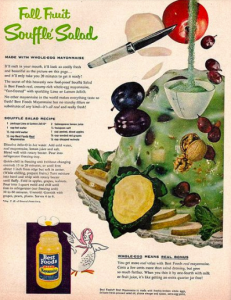
1 package Lime or Lemon Jell-O
1 cup hot water
Half a cup cup cold water
Half a cup Best Foods Real Mayonnaise
2 tablespoons lemon juice
Quarter teaspoon teaspoon slat
1 cup peeled, diced apples
Three quarter cups of seeded red grapes
Quarter cup chopped walnuts
Dissolve Jell-O in hot water. Add cold water, real mayonnaise, lemon juice and salt. Blend well with rotary beater. Pour into refrigerated freezing tray.
Quick-chill in freezing unit (without changing control) 15 to 20 minutes, or until firm about 1 inch from edge but soft in center. (While chilling, prepare fruits.) Turn mixture into bowl and whip with rotary beater until fluffy. Fold in apples, grapes, walnuts. Pour into 1 quart mold and chill until firm in refrigerator (not freezing unit) 50 to 60 minutes. Unmold. Garnish with grapes, pears, plums. Serves 4 to 6.
Post Author: Cindy Kok
Of Bags and Boxes: The Collecting and Display of Packaging
Like many of you, I am guilty of keeping packaging around my apartment way beyond the lifetime of the product it once held. From boxes of French macarons to sneakers, and a hoard of paper and plastic shopping and grocery bags underneath my sink, I am convinced I will use at some point. My reason for keeping these materials, which once housed food (which always go too quickly), clothing, or beauty products, amongst other things that are better stored outside their original packaging, is one of two. I either keep it because I appreciate its design (I am aware that many times I paid more because of the quality of this packaging and that I am indeed willing to pay more, because it was so aesthetically pleasing) or I keep it because of the prospect for reusability.
Packaging protects products and make convenient vessels for transportation, while simultaneously being informative about content and quality of the product inside. As much as the saying says “not to judge a book by its cover,” we do, we judge everything by the packaging it comes But if our main goal is to obtain what is inside the packaging why do some packages retain value even after their contents have been removed or consumed? In particular, what makes some packaging collectible and worthy of display?
At the Bard Graduate Center, objects matter, but truthfully not all for the same reasons. Upon browsing the selection of objects for the upcoming exhibition, Introspective: Contemplations on Curating, I realized that some of the objects can be considered packaging containers for products, which would have been more valued in their primary life as commodities. This potential grouping includes: (1) A Puma “Clever Little Bag,” (2) A Lucien Lelong perfume box and (3) a compact case (not pictured), (4) an apothecary jar, (5) a tea canister, (6) an Old Fitzgerald whiskey bottle, and finally (7) a set of five sake cups in their original box, a $22.95 price sticker included.
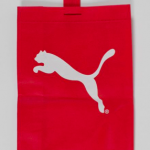 (1) is a book example of design, a solution to a problem combined with aesthetic consciousness, as it was a product of a redesign project with environmentally friendly goals, while (2) is a beautiful design pun, on the name of the perfume it once held, Mon Image, which is now missing.
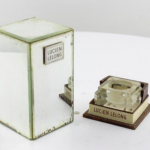 On the other hand, (3) still holds some powder inside the compact, but it is the metal container which now holds value as an example of cosmetic product design.
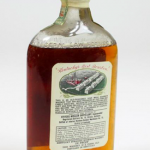 (6) is interesting because it remains unopened, holding the amber liquid people would have purchased this bottle for. Although, it could still be used as commodity, the story of the survival of this one whiskey bottle thwarts the power of commodity, as established by those who collected the bottle. (4) & (5)
once held tea & herbs, priced commodities, but it is their enduring functionality combined with their material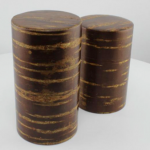
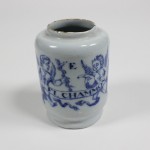 qualities that imbue them value. (7) is particularly interesting because although the reason why the box likely remains is for ease of storage of the cups, the price tag tells us more about the cups themselves.
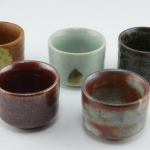
Here I presented one of the many ways in which these objects can be in conversation and be interpreted. Each year we spend hundreds and thousands of dollars just on packaging, which ends up in landfills, yet a very lucky few stand the test of time as someone chooses to pardon their life and preserve it for posterity for others to discover the stories that now fill these packaging containers.
A short bibliography on the history of packing and packaging design:
- The Total Package by Thomas Hine
- Package Design Workbook: The Art and Science of Successful Packaging by Steven DuPuis and John Silva
- Package and Print: The Development of Container and Label Design by Alec Davis
- Shelf Life: Modern Package Design, 1920-1945 by Jerry Jankowski
- Shelf Space: Modern Packaging Design, 1945-1965 by Jerry Jankowski
- The Art of the Label: Designs of the Times by Robert Opie
- Ecodesign by Silvia Barbero
Post Author: Angelik Vizcarrondo-Laboy
Moored in Milwaukee
Wonder what the Curatorial Team did while abroad?
Now you no longer have to wonder.
However, if you feel that this schedule does not reveal the brainstorming that occurred within object labs or the methodological debates had by all while we broke ginger cookies, that is intentional. Paragraph by paragraph of a team’s mental dexterity in pursuit of a goal is similar to football plays: distillable to circles and arrows, or in this case: times and activities.
Friday, March 4th
9AM: Officially done with midterms
9:30AM: Collective sighs of relief
11:30AM: Conjugate in the lobby of Bard Hall for taxi pickup
1PM: Arrive at the airport to hear that our flight has been delayed by 45 minutes
5:15PM: Board plane
To sit on the runway for half-an-hour due to sky traffic
7:30PM: Arrive in Milwaukee cold, tired, and hungry
8PM: Escorted to the Radisson Hotel
8:30PM: Retrieved from the Radisson and taken to the Chipstone Foundation
9PM: Brought to the carriage house and greeted with beer, (with or without root) as well as, barbeque and slaw.
Saturday, March 5th
8:30AM: Complimentary Breakfast
9:30AM: Pickup from Radisson
9:40 AM: Arrive to a snow-covered Chipstone Foundation
10AM: Object Lab: Blindfolded Object Description and Sketching
11:30 AM: Carriage House Tour: What is a Period Room?
12:30 PM: Lunch
2PM: Object Lab: Scavenger Hunt for a “controversial” object within the Chipstone Collection
3:30PM: Arrive to Milwaukee Art Museum-photo ops.
4PM: Tea Time Break
4:30PM: Chipstone Gallery Tours
6:05PM: Pabst Beer Mansion Tour
Dinner was had on the second floor landing. No beer was served.
Sunday, March 6th
10AM: Frank D. Vagnone’s lecture on Anarchist’s Guide to Historic House Museums
11AM: “Distinct Activity” Exercise
12PM: Input “Distinct Activity” data into a spreadsheet
Collective sigh of relief that we are not in the mathematics profession.
1:05PM: Excursion to Mrs. Stone’s liquor hideaway
Her martini mix is still going strong.
1:30PM: Milwaukee Art Museum
2:00PM: Lunch
3:00PM: Scheduled Mutiny-John Brown, Frank Vagnone, Sarah Carter, and Natalie Wright are given a diabolical object lab exercise from the group: Object Survivor.
4PM: Depart Milwaukee
Curatorial Statement
Introspective: Contemplations on Curating investigates and comments upon curatorial practice by recontextualizing objects from the Chipstone Foundation and the Bard Graduate Center Study Collection.Throughout this process, several key questions emerged. Why do we choose an object for an exhibition, and in what ways do our choices reveal subjectivity? How do curatorial decisions reflect and structure issues of visibility, value, collections development, and public engagement? Through this installation, staged in the Center’s Object Lab, we offer our responses.
Exhibitions depend on collaboration. Among the many contributors are: curators, registrars, collection managers, conservators, graphic and exhibition designers, preparators, educators, administrators, media specialists, event managers, fundraisers, donors, facilities and security staff, librarians and archivists, scholars and critics, and, at the most fundamental level, museum visitors. While these titles connote discrete roles, in practice they overlap, contradict, and blend with one another. Our aim is to offer a window–literally–into the complicated processes surrounding curatorial work and to highlight the active yet often invisible choices we make as a community when planning, experiencing, and participating in an exhibition.
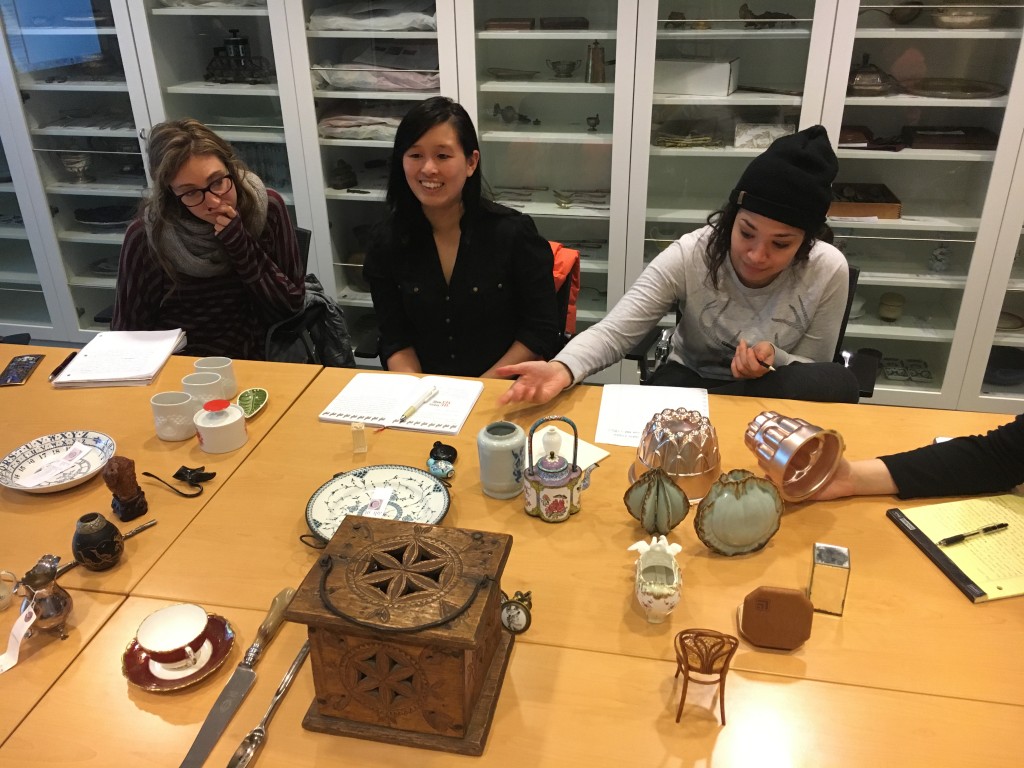
Clara, Cindy, and Angelik taking a crack at developing an object list.